International Leopard Day: Let Us Protect the King of the Wild
*International Leopard Day: Let Us Protect the King of the Wild*
Today, on the occasion of International Leopard Day, it is essential to raise awareness regarding the significance of leopards, the threats they face, and the measures required for their conservation. The leopard is one of the most efficient and agile animals within the forest ecosystem. Their striking appearance and swift movements captivate the hearts of many. Leopards play a pivotal role in maintaining the ecological balance of forest habitats and regulating the food chain. However, today, these magnificent creatures are facing grave threats. As we observe International Leopard Day, the time has come for us to reflect on the urgent need for all of us to work together collectively toward the conservation of leopards.
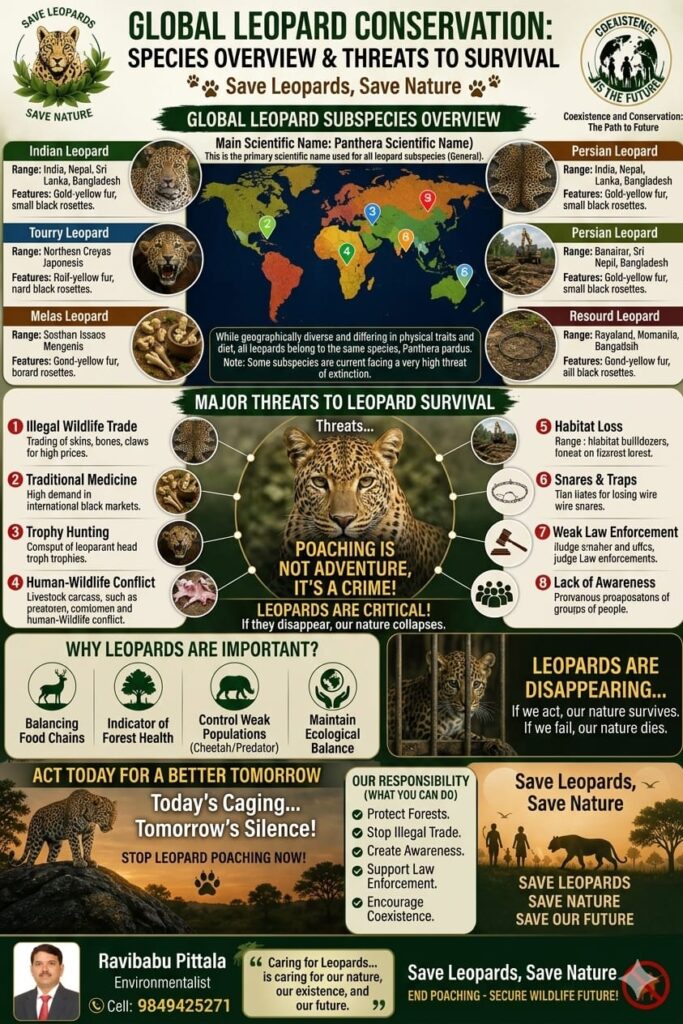
International Leopard Day is celebrated globally every year on May 3rd. For the year 2026, the central theme of this observance is: *“Leopards: Living in Harmony with Humans.”* The primary objective of this year’s theme is to explore and promote ways for leopards and humans to coexist safely and without conflict within the same regions—particularly against the backdrop of increasing urbanization and the shrinking of forest areas. *Leopard Subspecies and Varieties from an International Biodiversity Perspective:* Leopards are one of the major cat species distributed across the globe. Although they share a single scientific name, their subspecies vary depending on the specific country or region. The primary scientific name for the leopard is *Panthera pardus*; this is the name commonly applied to all leopards. Based on regional variations, the subspecies found in India and South Asia is known as *Panthera pardus fusca*, which is found in the regions of India, Nepal, Sri Lanka, and Bangladesh. Similarly, in Western and Central Asia, a distinct subspecies—*Panthera pardus saxicolor*—is found in regions such as Iran, Afghanistan, and the Caucasus. In East Asia, the subspecies is referred to as *Panthera pardus japonensis* (found in the northern regions of China). On the African continent, *Panthera pardus pardus* is the widely distributed subspecies found throughout Africa. Likewise, in Southeast Asia, the subspecies is recognized as *Panthera pardus delacouri* (found in Thailand, Vietnam, Laos, and Cambodia). Furthermore, *Panthera pardus melas* is a rare subspecies found exclusively on the island of Java in Indonesia. To elaborate further, *Panthera pardus kotiya* is a subspecies unique to Sri Lanka. Similarly, the *Panthera pardus orientalis*—native to the regions of Russia and Korea—is one of the most endangered subspecies in the world. It is particularly worth noting here that while all leopards belong to the same species (*Panthera pardus*), they have diversified into distinct subspecies due to geographical conditions, climate, and diet. Several of these subspecies are currently at risk of extinction (endangered).
*Threats to Leopards:* *Habitat Degradation:* Due to urbanization, agricultural expansion, and other human activities, the natural habitats of leopards are shrinking rapidly. As a result of habitat degradation, leopards face difficulties in finding food, water, and shelter. *Hunting:* Given the high demand for leopard skins and other body parts in the international market, poachers are illegally hunting them. This hunting is causing a significant decline in the leopard population. *Deforestation:* Deforestation leads to the destruction of leopard habitats and food sources. Furthermore, deforestation causes leopards to stray into human settlements, leading to human-leopard conflicts. *Human-Leopard Conflict:* As their natural habitats diminish, leopards venture into human settlements in search of food. This results in livestock loss and poses a threat to human life. Consequently, humans often kill leopards in self-defense to protect their own lives.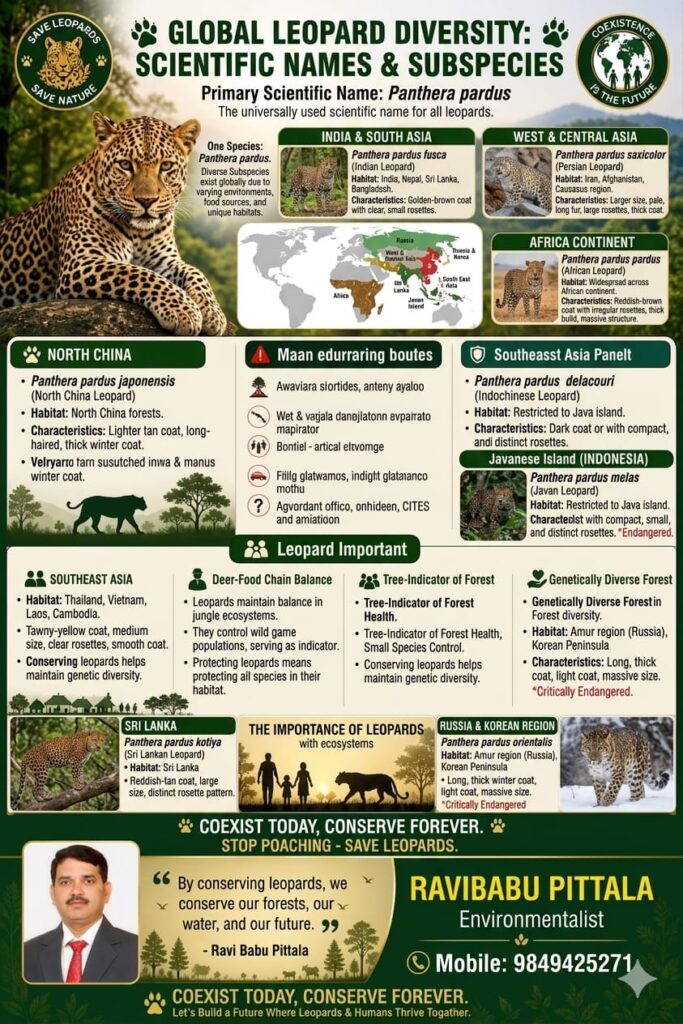
*Primary Causes of Leopard Hunting:* Various international reports indicate that the illegal wildlife trade is recognized as the third-largest illicit market globally. Within this context, the *hunting (poaching)* of leopards—specifically *illegal poaching*—remains a severe problem worldwide. The primary reason for the decline in their numbers is the illegal wildlife trade; leopard skins, bones, claws, and teeth fetch high prices in illicit markets. Another significant factor is the high international demand within these black markets. *Traditional Medicine:* In certain countries, leopard organs are utilized in traditional medical practices—specifically bones and teeth—driven by the misconception that they possess “medicinal properties.” *Trophy Hunting:* In some regions, leopards are hunted so that their heads and skins can be kept as trophies; there are hunters who view this practice as a symbol of prestige. *Human-Wildlife Conflict:* When leopards venture near villages and attack livestock, farmers often hunt them in retaliation; a lack of awareness regarding wildlife conservation also contributes to this issue. *Habitat Loss:* Deforestation drives leopards toward human settlements, leading people to perceive them as a threat and subsequently kill them. *Snares and Traps:* Leopards frequently get ensnared in traps set in the wilderness; although these traps are often intended for other animals, leopards often fall victim to them as well. Recently, in a district within our state, a cattle herder discovered the carcass of a leopard that had gone unnoticed for nearly a year. Upon receiving this information, senior forest officials initiated an investigation into the responsible authorities and took appropriate legal action. We frequently encounter such incidents reported in social media and newspapers. *Lack of Law Enforcement:* Despite the existence of legislation such as the Wildlife Protection Act, 1972, illegal hunting persists due to inadequate enforcement. *Lack of Awareness:* Leopards fall victim to a confluence of factors—including a lack of awareness among local communities regarding their ecological significance, as well as killings driven by fear or misconceptions. *Key Point to Remember:* Leopards play a pivotal role in maintaining the balance of the food chain; a decline in their population leads to environmental imbalance.
*The Necessity of Global Leopard Conservation:* *Maintaining Forest Ecosystem Balance:* Leopards occupy the apex position in the food chain. They prey on animals that are relatively scarce in number; this helps regulate the populations of these animals and establishes a state of equilibrium within the forest ecosystem. *Regulating the Food Chain:* Leopards hunt a diverse range of animals. This creates biodiversity within the food chain and ensures the overall health of the forest ecosystem. *Habitat Enhancement:* Prioritizing leopard conservation globally also leads to increased efforts in forest conservation. The preservation of forests improves the broader ecosystem and yields benefits for other wildlife species as well.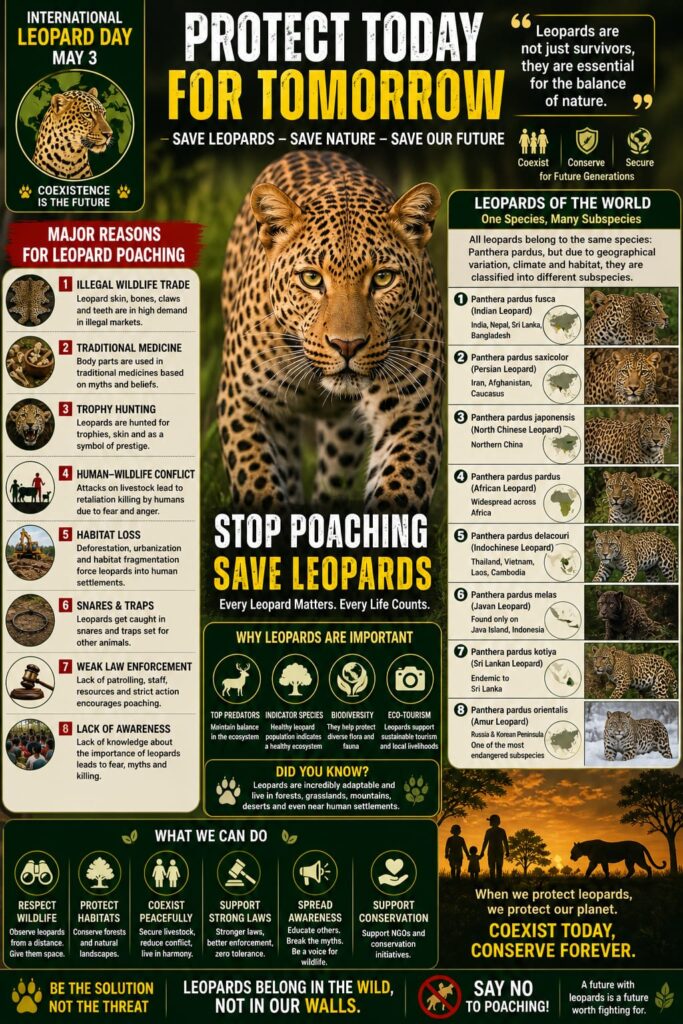
*Global Measures for Leopard Conservation:* *Controlling Deforestation:* Measures must be implemented to expand forest cover and curb deforestation. A strict ban should be imposed on the felling of trees. *Strict Enforcement of Anti-Poaching Laws:* Rigorous laws against the hunting of leopards must be enforced worldwide. Severe penalties should be imposed on poachers. *Preventing Human-Leopard Conflict:* Measures must be taken to prevent leopards from straying into human settlements. Necessary precautions should be adopted to protect livestock. In instances where human-leopard conflict does occur, provisions should be made to provide compensation for any resulting losses. *Citizens’ Responsibility:* The role of citizens is crucial in the conservation of leopards. Citizens must strive to protect forests and provide information to authorities regarding poachers. Globally—and particularly in India—wildlife laws must be strictly enforced; specifically, the *“Wildlife Protection Act, 1972,”* along with other forestry, environmental, and biodiversity laws, must be strengthened and rigorously implemented. *Forest Officials’ Responsibility:* Forest officials must play a pivotal role in the conservation of leopards. They are required to conduct patrols within the forests, apprehend poachers, and organize initiatives dedicated to leopard conservation.
Indeed, the leopard is the monarch of the forest. Its conservation is a responsibility shared by us all. On the occasion of International Leopard Day, let us all join hands and work collectively towards the conservation of leopards. Let us protect our forests, curb poaching, and prevent human-leopard conflicts. By saving the leopard, we safeguard our ecosystem and ensure a secure environment for our future generations. Here are a few actions we can take to aid in leopard conservation: Educate others about the importance of forests; if you possess information regarding poachers, report it to the authorities. Specifically in Telangana, information can be provided by calling 1800 4255 364 (Forest and Wildlife Crime Control, available 24/7); similarly, other states within India—as well as other countries—have their own dedicated numbers for reporting forest and wildlife crimes. We must fulfill our fundamental duty as enshrined in Article 51A(g) of the Indian Constitution. The identities of those who provide information will be kept strictly confidential. Support organizations dedicated to forest conservation, and actively participate in initiatives aimed at protecting leopards.
You, too, can play a vital role in the conservation of leopards. By safeguarding the leopard, we contribute our share toward preserving the ecosystem and ensuring a safe and secure environment for future generations.
*— Ravi Babu Pittala, Environmentalist; Former Assistant Professor, Centre for Water Resources, JNTUH, Hyderabad. Cell: ++91 9849425271*